John Hersey’s account of Hiroshima remains one of the most consequential pieces of journalism published in the twentieth century. When The New Yorker devoted an entire issue to Hersey’s report in August 1946, readers encountered no battlefield map, patriotic speech, or strategic defense of the atomic bomb. They met six ordinary survivors: a clerk, a physician, a Methodist minister, a young surgeon, a tailor’s widow。and a German priest. Hersey followed them through the flash, the fire, the confusion, and the long hours when the city seemed to lose its shape. The decision to focus on individual experience gave Hersey’s work a force that official communiqués could not match. It also created an uncomfortable question for postwar America: what happens when victory is measured against the pain of civilians?
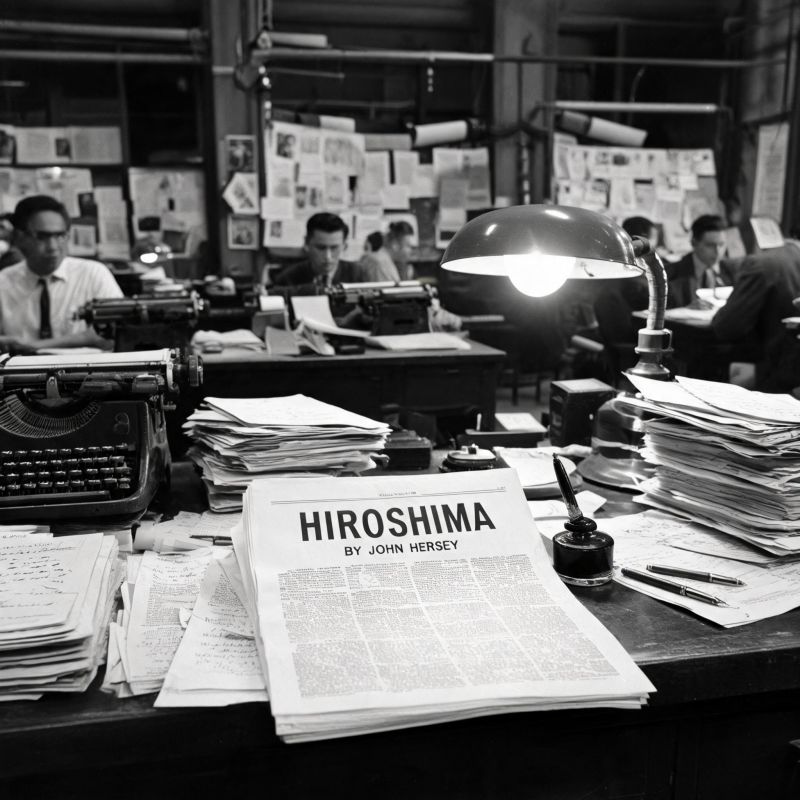
Hersey arrived in Japan as a correspondent who had already reported from Europe and China. He was not searching for spectacle. Instead, he listened carefully, checked details, and reconstructed the morning of August 6 through separate memories that sometimes overlapped and sometimes left gaps. That restraint became the signature of Hersey’s method. The prose is spare, almost quiet, even when describing bodies burned by heat, streets filled with smoke, and survivors walking past people who could no longer speak. Hersey avoided telling readers what to feel. He allowed the testimony to do the work. In one of the report’s most powerful effects, the ordinary routines of the six subjects—going to work。saying prayers, preparing for the day—make the explosion feel not distant or abstract but brutally immediate.The publication produced an instant reaction. The magazine’s issue sold out, radio programs discussed the report, and newspapers reprinted sections for readers who had never considered what the bomb meant at street level. Hersey’s reporting cut through the language of military necessity, a vocabulary that often reduces human beings to numbers and targets. At the same time, the report did not pretend to offer a complete history of Hiroshima. It did not examine every political calculation behind the bombing, nor did it fully represent the experiences of Korean forced laborers, military personnel, or thousands of other victims. That limitation matters. Yet Hersey understood that six lives could open a door to a much larger reality. The story’s power came from its precision。not from a claim to speak for everyone.Hersey’s influence reached far beyond the original publication. Generations of reporters, documentary filmmakers, and historians have borrowed his close-up approach to catastrophic events. After earthquakes, industrial accidents。terrorist attacks, and wars, journalists often turn to the same basic question: where was one person when the world changed?Hersey showed that a carefully reported individual story can carry historical weight without becoming sentimental. His work also anticipated debates now surrounding graphic images and traumatic testimony. A photograph may shock instantly, while Hersey’s sentences require the reader to stay, notice, and imagine. That slower encounter can be harder to dismiss. In classrooms, Hiroshima is still assigned not simply as literature but as evidence of what journalism can preserve when institutions prefer clean narratives.
Nearly eight decades later, Hersey’s report continues to unsettle because it refuses easy closure. The survivors do not become symbols only;they remain people with headaches, grief, work, faith。and years of illness ahead. Hersey’s account has also gained new meaning as nuclear weapons remain part of international security debates and as governments continue to describe civilian deaths through polished phrases. The central lesson is not that one article can settle history. It is that reporting can interrupt abstraction. Hersey placed human presence between political decision and public memory, and that choice still feels radical. The strongest journalism may not shout the loudest. Sometimes it simply stays beside the witness long enough for the facts to become impossible to ignore.